
I use cashback apps.
I do not have a favorite.
That may be less satisfying than a dramatic ranking with a gold medal, a winner’s podium, and one app wearing a tiny promotional hat. But cashback services are not sports teams, and I am not choosing one for life.
I am choosing the best worthwhile offer for a particular purchase at a particular time.
The two services I can honestly name from my own experience are Rakuten and ShopBack. I have earned and redeemed cashback through both. What I will not do is turn that into a generic “best cashback apps” list or invent personal likes and dislikes because a tidy pros-and-cons table would look nice here.
My real strategy is more useful than that:
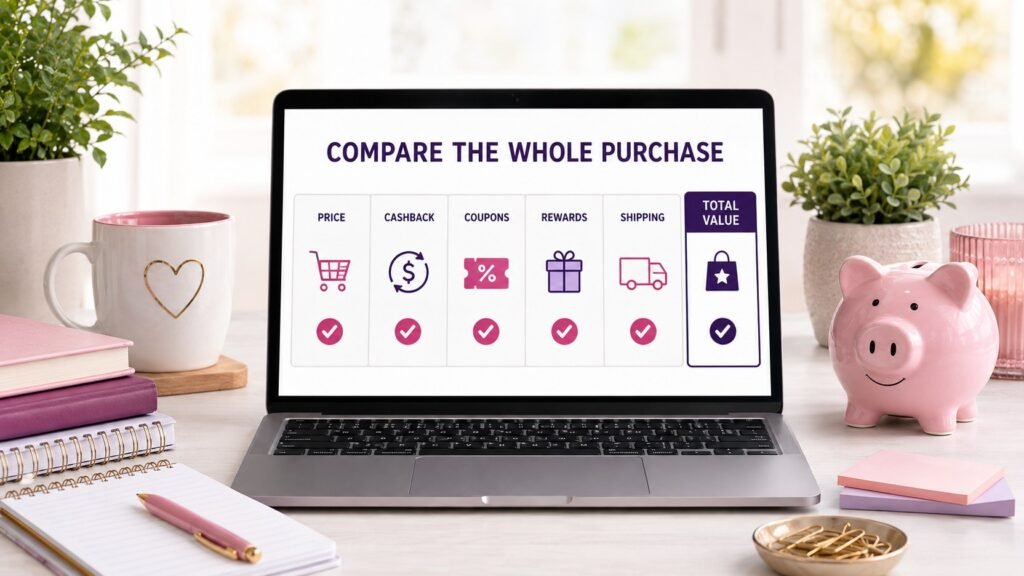
Cashback is only one column in the comparison.
A large cashback percentage can improve a good purchase. It cannot rescue a bad starting price, an ineligible product, an incompatible coupon, expensive shipping, or something I did not need until a promotion began following me around the internet.
The cashback number gets my attention. The whole purchase gets the decision.
I Compare the Product Before I Compare the Cashback
Before cashback can matter, I need to know what the item costs elsewhere.
For the same product, my general retailer comparison set includes Amazon, Walmart, Target, AliExpress, Temu, TikTok Shop, Costco, and Sam’s Club when they are relevant to the purchase. For keyboards, I usually narrow that comparison to Temu, Amazon, TikTok Shop, and AliExpress.
The exact product or configuration still matters. A different size, model, seller, bundle, or delivery promise is not automatically the same deal just because the thumbnail looks familiar.
This is where the loud cashback offer has to wait its turn. If one retailer has a much better base price, a competing store may still win with no cashback at all.
My research brain does not allow the exciting percentage to skip the methods section.
The Percentage Is Not the Final Price
Here is a deliberately simple hypothetical example—not a current offer from any retailer or service:
| Retailer A | Retailer B | |
|---|---|---|
| Exact-item price | $100 | $88 |
| Compatible checkout coupon | $0 | $0 |
| Amount due before tax | $100 | $88 |
| Expected later cashback | $10 | $0 |
| Comparison amount after expected cashback | $90 | $88 |
Retailer A advertises 10% cashback. Retailer B advertises none. Retailer B still has the lower comparison amount.
And that is before checking shipping, fees, delivery time, return terms, seller reliability, or whether Retailer A’s purchase would actually qualify.
This is why “10% cashback” and “10% off” are not interchangeable. A checkout discount reduces what is due now. Cashback generally arrives later, after the transaction tracks, remains eligible, and is confirmed.
I do not treat expected cashback as money already in my hand. First, the actual checkout total has to fit. Then the potential cashback can be considered as a later benefit.
A practical way to keep the math honest is to calculate two numbers:
- What leaves the budget now: item price minus valid checkout discounts, plus shipping, taxes, and required fees.
- What the purchase may effectively cost later: the checkout total minus cashback that is reasonably expected under the current terms, plus or minus other value that will genuinely be used.
The word expected is doing important work. Pending cashback is not guaranteed savings.
Where Rakuten Fits for Me
I can say this plainly: I have actually earned and redeemed Rakuten cashback. My documented experience includes cashback confirmations, a payment through PayPal, and Amazon gift-card redemptions.
One of those redemptions became an $8.40 Amazon gift card that I used toward a rush pet-item purchase. That is a separate case study because the small, practical examples are often more honest than the giant promotional numbers. The gift card helped with the purchase; it did not make the entire order free.
It also had nothing to do with the separate Chewy Timothy hay purchase for my rabbits. Fifteen bunnies already create enough plot without combining two unrelated transactions.
I know from my own records that I was actively using Rakuten by at least March 2026. I may have started earlier, but I’m not going to invent a date just to make the story tidier.
Where ShopBack Fits for Me
I’ve used ShopBack across purchases from Amazon, Temu, Chewy, Whatnot and other merchants, and I’ve successfully withdrawn cashback from it. The offers change—which is exactly why I check what’s available instead of permanently crowning one service the winner.
For this article, the useful truth is simple: Rakuten and ShopBack are both real options in my comparison. Which one wins depends on the purchase and the current terms.
The Highest Offer Still Has to Be Worthwhile
I generally use the cashback service offering the highest worthwhile cashback for the purchase at that time.
Worthwhile is the important word.
An offer may look higher and still lose because:
- the product category is excluded;
- the advertised rate applies only to a different customer or purchase type;
- the coupon I want to use is not compatible;
- the retailer’s starting price is higher;
- shipping or required fees erase the advantage;
- the redemption option is not useful for the way the value will actually be used;
- the purchase has weaker return, delivery, or seller terms; or
- the extra reward is too small to justify disproportionate time, tracking risk, or complexity.
Cashback can be part of the win. It does not get to declare itself the winner before the rest of the cart arrives.
Coupons Count—When They Are Compatible
I combine coupons when they are available and compatible with the cashback offer.
The compatibility part is not decorative fine print. An outside code may invalidate cashback even when the retailer accepts the code at checkout. That can turn an impressive stack into a future customer-service hobby.
Before relying on both benefits, check the cashback service’s current merchant terms and the coupon source. If the code is not permitted, compare both legitimate paths:
- retailer price plus the valid coupon, without expected cashback; and
- retailer price through the eligible cashback path, without the incompatible code.
Use the result that produces the better legitimate total value. The goal is not to force every savings tool into one cart. The goal is to let the strongest compatible combination win.
Beauty Is a Newer Experiment, Not an Established Routine
My general retailer-comparison habits are established. My Ulta and Sephora beauty strategy is newer and still evolving.
I have recently begun looking at Ulta for beauty purchases, and I plan to include Sephora in future comparisons. I am interested in how several forms of value interact: the base price, cashback, compatible coupons, gift-card opportunities, retailer rewards, and what those rewards are actually worth to me later.
That does not mean I have a settled Ulta-versus-Sephora system or a history of using ShopBack at either retailer. Offers from those retailers have appeared in cashback promotions, but promotional availability is not the same as my firsthand purchase history.
I am still testing and refining this part of the method. When there is enough real experience to support a conclusion, then I can explain what worked. Until then, the honest answer is that the research is in progress.
My Whole-Purchase Cashback Check
Before deciding that a cashback offer improves a purchase, I ask:
- Is this the exact product or configuration I want?
- What is the real price across the relevant retailers?
- What will I actually pay at checkout after valid discounts, shipping, taxes, and fees?
- What are Rakuten and ShopBack offering for this merchant and category right now?
- Is the offer available to me and is the product eligible?
- Is the coupon I want to use compatible with that cashback path?
- What could prevent the purchase from tracking or remaining eligible?
- Is the later redemption method useful to me?
- Does the purchase still make sense without counting unconfirmed cashback?
- Is the expected value worth the time and complexity?
Consumers should also keep the terms and purchase confirmation needed to investigate missing cashback without publicly exposing private account or transaction information.
The Method Matters More Than the Link
There are no referral links in this article right now, and that’s fine. The useful part is the method: compare the exact item, retailer price, current cashback, compatible coupons, other rewards and what actually leaves your budget.
If I add referral links later, I’ll disclose them. The presence of a monetized link will never be evidence that one service is better than another.
The Bottom Line
I use Rakuten and ShopBack, but I am not shopping for a cashback app. I am shopping for the right product at the best legitimate total value.
Sometimes the highest worthwhile cashback offer helps produce that result. Sometimes a lower base price, a compatible coupon, useful store rewards, better shipping, or stronger purchase terms wins instead.
The winning service can change from one purchase to the next. That is fine. I do not need a favorite.
My loyalty is to the math—and to not letting an exciting percentage boss around the entire shopping cart.
Editorial promise: Recommendations remain independent. Affiliate links may earn Shopping Guru PhD a commission at no added cost to you.